
Explore the Cutting – Edge World of PCB Technology!
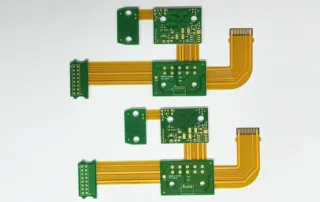
What are the core challenges in manufacturing Flex pcb?
As the “flexible nerves” of electronic devices, the manufacturing of FPC boards represents a precision art in modern industry. In smartphones, FPCs just 0.03mm thick must carry 10A currents; in satellite antennas, multilayer FPCs endure extreme temperature cycles from -180°C to 200°C. These seemingly contradictory performance metrics are precisely why FPC technology has long been pushed to the limits of[...]
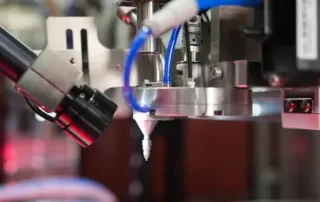
Precision Laser Soldering for FPCBs: Low Heat, High Reliability in Wearables and Medical Electronics
In fields such as consumer electronics, medical electronics, and wearable devices, flexible printed circuit boards (FPCBs) have become the core medium for achieving product miniaturization and structural innovation due to their characteristics of being lightweight, thin, bendable, and resistant to repeated bending. However, the substrate materials of Flex PCBs (such as PI film and PET film) exhibit poor heat resistance[...]
Advanced Manufacturing Technologies for High-Current, High-Shielding FPCB Solutions
In recent years, with the rapid development of the intelligent connected vehicle industry, the demand for flexible printed circuit boards (FPCBs) has continued to grow. Statistics indicate that each smart connected vehicle utilizes over 100 FPCBs. Driven by modern market demands, FPCBs are increasingly replacing rigid circuit boards in fields such as low-altitude aircraft and military applications. This shift enables[...]
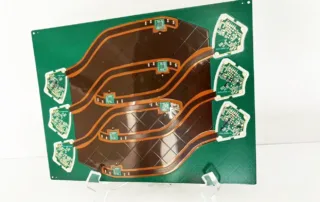
How to Achieve High Precision in Flexible Copper Clad Laminates Using Dual-Laser Etching?
Flexible copper-clad laminate (FCCL), serving as the substrate material for flexible printed circuits (FPC), offers distinct advantages such as lightweight, flexibility, compact size, and excellent heat resistance. Manufacturers widely adopt it in electronic products to achieve miniaturization and portability. This approach aligns with the development trends of high-precision electronics industries such as micro-robotics, new energy vehicles, 5G communication devices, and[...]
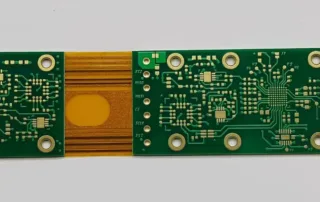
What Are the Best Methods to Improve PCB Micro-Drill Performance on Flex Boards?
Manufacturers produce Flexible Printed Circuit Boards (FPCBs), commonly referred to as flexible circuit boards, as highly reliable printed circuit boards with exceptional flexibility, using polyimide or polyester film as the substrate material. Compared to rigid circuit boards, flexible boards offer inherent flexibility, ease of bending, lightweight properties, and thin profile advantages. Structurally, manufacturers form flexible boards by bonding a[...]
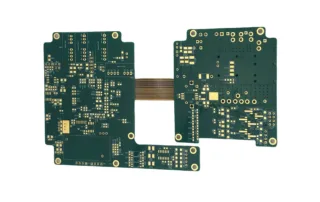
Research on the Manufacturing Process of Semi-Rigid Flex Printed Circuit Boards
Semi-rigid printed circuit boards form a type of rigid-flex printed circuit board (R-FPCB). The conventional rigid board manufacturing process produces them by milling or cutting out openings (windows) in areas requiring flexibility. They eliminate the need for expensive flexible materials like polyimide (PI), reducing costs while offering more stable electrical performance. These boards commonly serve in static or semi-dynamic[...]
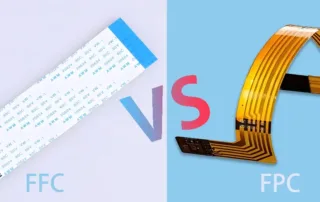
FFC vs FPC: Which One Fits Your Design Best?
1. Introduction Flexible electronics have revolutionized the design of modern devices. They are instrumental in batteries. These electronics save space and provide high-performance electrical connections. FFC (Flexible Flat Cable) and FPC (Flexible Printed Circuit) are among the most commonly used flexible interconnects. Although they appear to be quite similar at a glance, their structures, functions, and uses vary greatly. Here, we outline[...]