
Adhesive vs Adhesiveless Flex PCB Construction
In flexible printed circuit design, the construction method—specifically whether the copper conductor is bonded to the polyimide substrate using an adhesive layer or directly bonded without adhesive—is one of the most consequential structural decisions an engineer can make.
Adhesive-based flex PCBs rely on a polymer bonding layer to laminate copper foil to the substrate, while adhesiveless flex PCBs form a direct copper-to-polyimide interface through casting or sputtering processes.
Why Construction Method Matters in Flex PCB Design
This choice has a measurable impact on dynamic bending life, thermal reliability, signal integrity, and long-term failure behavior. In applications involving repeated flexing, even a few microns of additional polymer can significantly alter strain distribution across the copper layer.
Thermally, adhesive materials typically exhibit higher coefficients of thermal expansion (CTE) and lower glass transition temperatures than polyimide, which increases the risk of delamination and copper fatigue during thermal cycling.
Electrically, dielectric discontinuities introduced by adhesive layers can degrade impedance control and increase loss at higher frequencies.
For these reasons, flex PCB construction method selection should be treated as a core design and manufacturing decision, comparable in importance to layer count or copper thickness.
This article examines adhesive-based flex PCB construction from an engineering standpoint, focusing on structure, manufacturing behavior, performance boundaries, and failure mechanisms rather than material branding or supplier-specific solutions.
What Defines Flex PCB Construction Methods?
Flex PCB construction methods are defined by how the copper conductor is integrated with the polyimide substrate. In adhesive-based constructions, rolled annealed (RA) or electrodeposited (ED) copper foil is laminated to the polyimide using an intermediate adhesive layer.
In adhesiveless constructions, copper is formed directly on the substrate surface, eliminating the bonding layer entirely.
This construction choice exists within the broader context of flex PCB stack-up design and interacts directly with substrate thickness, copper type, and mechanical reliability in bend zones.
Adhesive layers typically add 12–25 µm of thickness per side, which may appear minor but becomes mechanically significant when total circuit thickness is below 100 µm.
As bending strain is proportional to distance from the neutral axis, even small increases in thickness can reduce fatigue life by orders of magnitude in dynamic applications.
Copper type further amplifies this effect. Rolled annealed copper, with its elongated grain structure aligned in the rolling direction, exhibits superior fatigue resistance compared to electrodeposited copper.
However, the benefits of RA copper can be partially negated if bonded with a compliant adhesive layer that allows micro-slippage and stress concentration under cyclic bending.
Consequently, construction method, copper selection, and bend zone placement must be evaluated as an integrated system rather than independent variables.
Adhesive Flex PCB Construction
Structure and Stack-Up
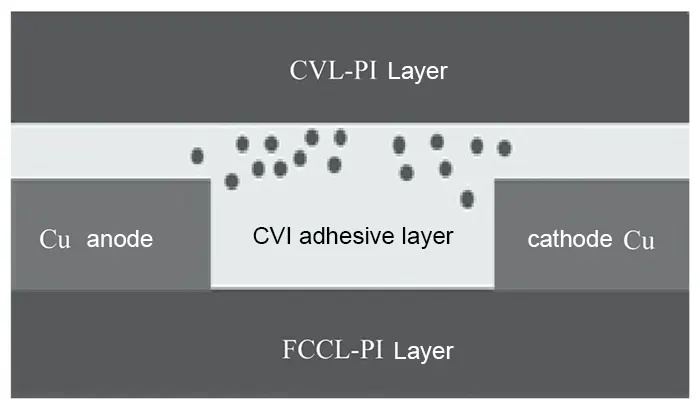
An adhesive-based flex PCB typically consists of a polyimide substrate layer bonded to a copper foil using a polymer adhesive, with an overall structure that is subsequently protected by a polyimide coverlay.
The adhesive layer, usually epoxy- or acrylic-based, serves as the mechanical and thermal interface between copper and substrate.
Common adhesive thicknesses range from 12 µm to 25 µm, which can account for 20–40% of the total circuit thickness in thin flex designs.
Epoxy adhesives are favored for their strong bond strength and relatively high thermal resistance, while acrylic adhesives offer greater flexibility but lower thermal stability.
Regardless of chemistry, the adhesive layer introduces a mechanically distinct region within the stack-up, with lower modulus and higher CTE than both copper and polyimide. This mismatch plays a critical role in how strain is distributed during bending and thermal cycling.
Manufacturing Process Overview
Adhesive-based flex PCBs are manufactured through a lamination process in which copper foil is bonded to the polyimide substrate under controlled heat and pressure.
Typical bonding temperatures range from 160 °C to 200 °C, depending on adhesive formulation, with lamination pressures carefully balanced to avoid resin squeeze-out or void formation.
From a production standpoint, this process is mature and widely supported across the flex PCB supply chain. Yield rates are generally high for simple constructions, and material sourcing is relatively flexible.
However, adhesive flow behavior during lamination introduces variability in thickness and dimensional stability, particularly in large panel formats or fine-feature designs.
These variations can complicate downstream processes such as laser drilling, coverlay alignment, and impedance control.
Advantages of Adhesive-Based Flex PCBs
The primary advantage of adhesive-based flex construction lies in cost efficiency and manufacturing accessibility.
Raw material costs are lower than adhesiveless alternatives, and a wider range of suppliers can support this construction without specialized deposition equipment.
For applications involving static flexing or limited bend cycles, adhesive-based constructions often meet reliability requirements at a substantially lower unit cost.
As a result, adhesive flex PCBs are commonly selected for cost-sensitive designs, low-cycle bending applications, and assemblies where mechanical motion occurs primarily during installation rather than operation.
In these contexts, the additional thickness and material interfaces do not materially affect product performance or lifespan.
Limitations and Failure Risks
Despite their economic advantages, adhesive-based flex PCBs exhibit well-documented limitations under demanding mechanical and thermal conditions.
Adhesive materials typically soften at elevated temperatures, with glass transition temperatures often below 150 °C, leading to reduced mechanical support for the copper conductor.
Under repeated bending, this softening accelerates copper fatigue and promotes interfacial delamination.
Moisture absorption is another concern, particularly for acrylic-based adhesives, which can absorb up to 1–2% moisture by weight. This absorption degrades dielectric properties and increases the risk of blistering during reflow soldering.
Additionally, the adhesive layer contributes to reduced dimensional stability over temperature, with CTE values significantly higher than polyimide, resulting in increased stress during thermal cycling.
In long-term service, these mechanisms manifest as conductor cracking, pad lift, or gradual impedance drift—failure modes that are difficult to detect during initial testing but costly in field applications.
For designs requiring high cycle life, tight impedance control, or extended exposure to elevated temperatures, adhesive-based flex construction often represents a hidden reliability risk rather than a safe default choice.
Adhesiveless Flex PCB Construction
Structure and Stack-Up
Adhesiveless flex PCB construction is characterized by a direct metallurgical bond between the copper conductor and the polyimide substrate, eliminating the intermediate adhesive layer entirely.
In this architecture, copper is either cast or deposited directly onto the polyimide surface, forming a uniform interface with no compliant polymer layer between materials of vastly different mechanical properties.
The absence of adhesive results in a significantly thinner overall stack-up. In practical terms, a single-layer adhesiveless flex circuit with 12 µm polyimide and 12 µm copper can achieve a total thickness of approximately 25–30 µm before coverlay, compared to 45–60 µm for an equivalent adhesive-based construction.
This reduction in thickness shifts the copper closer to the neutral axis during bending, dramatically lowering strain energy accumulation in the conductor and improving fatigue resistance.
From a mechanical standpoint, the copper–polyimide interface behaves as a unified composite rather than a layered assembly. This uniformity is a key factor in the superior long-term reliability of adhesiveless flex circuits in dynamic applications.
Manufacturing Techniques
Adhesiveless flex PCBs are produced using specialized manufacturing processes such as copper casting, sputtering, or chemical deposition directly onto the polyimide film.
In cast copper processes, molten copper is applied to the substrate and solidified under controlled conditions, producing rolled annealed–like grain structures with excellent ductility.
Sputtering and chemical bonding techniques, while more capital-intensive, allow extremely precise thickness control and surface uniformity.
These processes require significantly tighter control over surface cleanliness, deposition parameters, and thermal profiles than adhesive lamination.
Minor deviations in process conditions can directly affect copper adhesion strength or grain morphology, which in turn influences bend fatigue life.
As a result, adhesiveless flex fabrication is typically limited to manufacturers with advanced process monitoring and in-line inspection capabilities.
The higher level of process control also yields improved consistency in finished circuit dimensions, which is particularly important for fine-pitch component assembly and impedance-controlled signal routing.
Performance Advantages
The most widely cited advantage of adhesiveless flex PCB construction is its superior performance under dynamic bending conditions.
Independent fatigue testing and IPC-based studies consistently show that adhesiveless flex circuits can withstand 5 to 10 times more bend cycles than adhesive-based equivalents when bent at the same radius.
In controlled tests at a bend radius of 10 times circuit thickness, adhesiveless designs routinely exceed 10 million cycles, while adhesive-based constructions often fail between 1 and 2 million cycles.
Thermal stability is another critical advantage. Polyimide maintains mechanical integrity well above 300 °C, whereas most flex adhesives begin to soften or degrade below 150–180 °C.
By eliminating the adhesive layer, adhesiveless flex circuits exhibit minimal property change across standard solder reflow and extended high-temperature operating conditions. This stability directly reduces the risk of interfacial delamination and copper cracking during thermal cycling.
Dimensional accuracy is also improved. Without adhesive flow during lamination, line width, spacing, and via registration are more consistent across temperature variations.
Electrically, the homogeneous dielectric environment reduces dielectric loss and impedance variation, making adhesiveless flex particularly well suited for high-speed digital interfaces and RF signal transmission.
Measured insertion loss improvements of 10–20% at multi-gigahertz frequencies have been reported when comparing adhesiveless constructions to adhesive-based flex with equivalent geometries.
Trade-Offs and Cost Considerations
These performance gains come at a measurable cost. Adhesiveless materials are more expensive, and the associated fabrication processes require specialized equipment with lower throughput compared to conventional lamination.
As a result, unit costs for adhesiveless flex PCBs are typically 20–50% higher than adhesive-based alternatives, depending on volume and complexity.
The supplier base capable of producing adhesiveless flex at scale is also more limited, which can affect lead times and sourcing flexibility.
In addition, design rules tend to be more stringent, particularly with respect to minimum bend radius, copper balancing, and coverlay design, as the tighter tolerances demand greater discipline in layout and stack-up planning.
For cost-driven or mechanically benign applications, these trade-offs may not be justified. However, in systems where mechanical reliability, signal integrity, or thermal endurance are mission-critical, the higher initial cost is often offset by reduced failure rates and longer service life.
Adhesive vs. Adhesiveless Flex PCB: Side-by-Side Comparison
When evaluated holistically, adhesive-based and adhesiveless flex PCB constructions represent two fundamentally different engineering philosophies. The table below summarizes their key performance differences in quantitative and application-oriented terms.
| Parameter | Adhesive-Based Flex PCB | Adhesiveless Flex PCB |
|---|---|---|
| Typical total thickness (single-layer) | 45–60 µm | 25–30 µm |
| Copper-to-substrate interface | Polymer adhesive | Direct copper–polyimide bond |
| Dynamic flex life (10× thickness radius) | ~1–2 million cycles | >10 million cycles |
| Thermal resistance | Limited by adhesive Tg (≤180 °C) | Polyimide-limited (>300 °C) |
| Delamination risk | Moderate to high under cycling | Very low |
| Dimensional stability | Moderate | High |
| Dielectric loss (high-speed signals) | Higher | Lower |
| Manufacturing cost per unit | Low to medium | Medium to high |
| Supplier availability | Wide | Limited |
| Typical applications | Static flex, low-cycle motion, consumer electronics | Dynamic flex, high-speed signals, medical, aerospace, precision electronics |
This comparison illustrates that construction method selection is not a marginal optimization but a structural decision that defines the operating envelope of the flex PCB.
Adhesive-based flex remains a valid and economical solution for many products, but adhesiveless construction has become the default choice in applications where mechanical motion, thermal stress, or signal integrity cannot be compromised.
Impact on Dynamic Bending and Flex Life
Dynamic bending performance is fundamentally governed by how mechanical strain is distributed across the flex PCB cross-section, and the construction method plays a decisive role in this distribution.
In adhesive-based flex circuits, the presence of a relatively thick, low-modulus adhesive layer shifts the neutral axis away from the copper conductor.
This shift increases tensile and compressive strain in the copper during each bend cycle, accelerating microcrack initiation along grain boundaries. The effect is particularly pronounced in thin constructions, where a 15–25 µm adhesive layer can represent a substantial fraction of the total thickness.
Adhesive layers also introduce localized stress concentrations in bend zones. Because adhesives deform differently from both copper and polyimide, repeated bending leads to shear stress at the copper–adhesive interface.
Over time, this manifests as copper cracking, interfacial delamination, or pad lifting, even when bend radii nominally comply with design guidelines.
These failure modes often appear after extended cycling rather than during initial qualification testing, making them especially problematic in field applications.
By contrast, adhesiveless construction significantly increases flex life by creating a more mechanically uniform composite. With copper directly bonded to polyimide, the neutral axis moves closer to the copper layer, reducing cyclic strain.
The absence of a compliant adhesive layer eliminates interfacial shear and suppresses crack initiation sites. In practical terms, this translates into order-of-magnitude improvements in flex cycle endurance.
In real-world applications such as laptop hinges, foldable consumer devices, and robotic arm cable assemblies, adhesiveless flex circuits consistently demonstrate stable electrical performance after millions of cycles, whereas adhesive-based designs frequently require over-design or early replacement.
Electrical and Signal Integrity Considerations
From an electrical standpoint, the flex PCB construction method influences signal behavior through dielectric uniformity and geometric stability. Adhesive layers introduce variability in dielectric thickness due to resin flow during lamination, which directly impacts impedance control.
Even small variations in adhesive thickness can cause measurable impedance discontinuities, particularly in controlled-impedance transmission lines used for high-speed digital or RF signals.
Adhesiveless flex circuits benefit from a more uniform dielectric environment, as the copper-to-polyimide interface is precisely defined during deposition. This uniformity enables tighter impedance tolerances and more predictable signal propagation.
At high frequencies, where dielectric loss and surface roughness dominate insertion loss, the absence of adhesive material reduces energy dissipation and phase distortion. Measured performance improvements include lower insertion loss, reduced signal skew, and improved eye diagrams at multi-gigabit data rates.
Electromagnetic compatibility is also affected. Adhesive-based constructions can exacerbate crosstalk due to inconsistent spacing between signal and reference conductors, while adhesiveless designs maintain stable geometries under thermal and mechanical stress.
For these reasons, adhesiveless construction has become the preferred choice for high-speed interfaces, RF interconnects, and mixed-signal flex circuits where signal integrity margins are limited.
8. Thermal Reliability and Environmental Resistance
Thermal reliability is another domain where construction differences become critical over the product lifecycle. Adhesive materials generally exhibit lower glass transition temperatures and higher coefficients of thermal expansion than polyimide.
Under repeated thermal cycling, particularly in environments with wide temperature swings, these properties lead to progressive adhesive degradation. Softening at elevated temperatures reduces mechanical support for the copper, while shrinkage during cooling increases interfacial stress.
In automotive environments, where operating temperatures may range from –40 °C to 125 °C with frequent cycling, adhesive-based flex circuits are more susceptible to delamination and copper fatigue.
In aerospace applications, exposure to vacuum and radiation can further accelerate adhesive outgassing and embrittlement. Medical devices introduce additional challenges, as repeated sterilization processes such as autoclaving or chemical exposure can degrade adhesive bonds and alter dielectric properties.
Adhesiveless flex circuits, relying solely on polyimide and copper, exhibit superior stability across these environments.
Polyimide maintains mechanical integrity at temperatures well above standard soldering profiles and shows minimal property change under radiation or chemical exposure.
As a result, adhesiveless constructions offer more predictable long-term performance in demanding thermal and environmental conditions.
Design Guidelines: When to Choose Each Construction Method
Construction method selection should be driven by application requirements rather than default cost assumptions.
Adhesive-based flex PCBs remain appropriate when flexing is static or limited to installation, when cost pressure dominates the design equation, and when thermal exposure is moderate and well controlled.
In such cases, the mechanical and electrical limitations of adhesive layers do not materially affect product performance.
Adhesiveless flex PCBs are the more appropriate choice when dynamic bending is integral to product function, when long flex life and high reliability are critical, or when high-speed or RF signals demand tight impedance control and low dielectric loss.
In these applications, the higher initial cost of adhesiveless construction is typically offset by reduced failure rates, longer service life, and lower total cost of ownership.
Common Design Mistakes Related to Flex PCB Construction
A recurring design error is the use of adhesive-based flex circuits in areas subjected to continuous motion, often driven by early cost optimization without full lifecycle analysis.
Another frequent oversight is underestimating the impact of adhesive thickness on bend radius and fatigue life, particularly in compact assemblies where every micron matters.
Incorrect copper selection, such as pairing electrodeposited copper with adhesive construction in dynamic bend zones, further compounds reliability risks.
Designers also commonly overlook moisture absorption and thermal aging effects, which may not manifest during short-term testing but dominate long-term field performance.
Manufacturing and DFM Considerations
From a manufacturing perspective, construction method selection must be aligned with supplier capability. Not all flex PCB manufacturers possess the process control, inspection infrastructure, or experience required for reliable adhesiveless fabrication.
Yield considerations also differ: adhesive-based flex generally offers higher initial yields, while adhesiveless flex prioritizes consistency and long-term reliability over throughput.
Effective DFM collaboration involves balancing yield and reliability objectives, selecting inspection methods appropriate to construction complexity, and optimizing panel utilization without compromising bend zone integrity.
Cost optimization strategies should focus on lifecycle cost rather than piece price, particularly for products with long service lives or limited field serviceability.
Future Trends in Flex PCB Construction
Flex PCB construction technology continues to evolve toward thinner, more integrated solutions. Ultra-thin adhesiveless laminates are enabling tighter bend radii and higher dynamic cycle counts.
Hybrid constructions, combining adhesive-based rigidized zones with adhesiveless dynamic sections, are emerging as a practical compromise between cost and performance.
Integration with rigid-flex architectures is accelerating, driven by demand for assembly consolidation and improved reliability.
At the same time, advances in high-frequency and high-power flex circuits are pushing construction methods toward tighter tolerances and more robust material systems.
Conclusion: Construction Choice Defines Flex PCB Reliability
The choice between adhesive-based and adhesiveless flex PCB construction is not merely a cost-driven decision; it fundamentally defines mechanical reliability, electrical performance, and environmental resilience.
Application-driven selection, grounded in an understanding of dynamic bending behavior, thermal exposure, and signal integrity requirements, is essential to achieving reliable products.
Organizations that evaluate construction methods in terms of lifecycle reliability and total cost of ownership, rather than initial fabrication cost alone, consistently achieve better outcomes.
Flex PCB manufacturer’s role extends beyond fabrication to that of a technical partner, supporting informed design decisions that align performance, manufacturability, and long-term reliability.